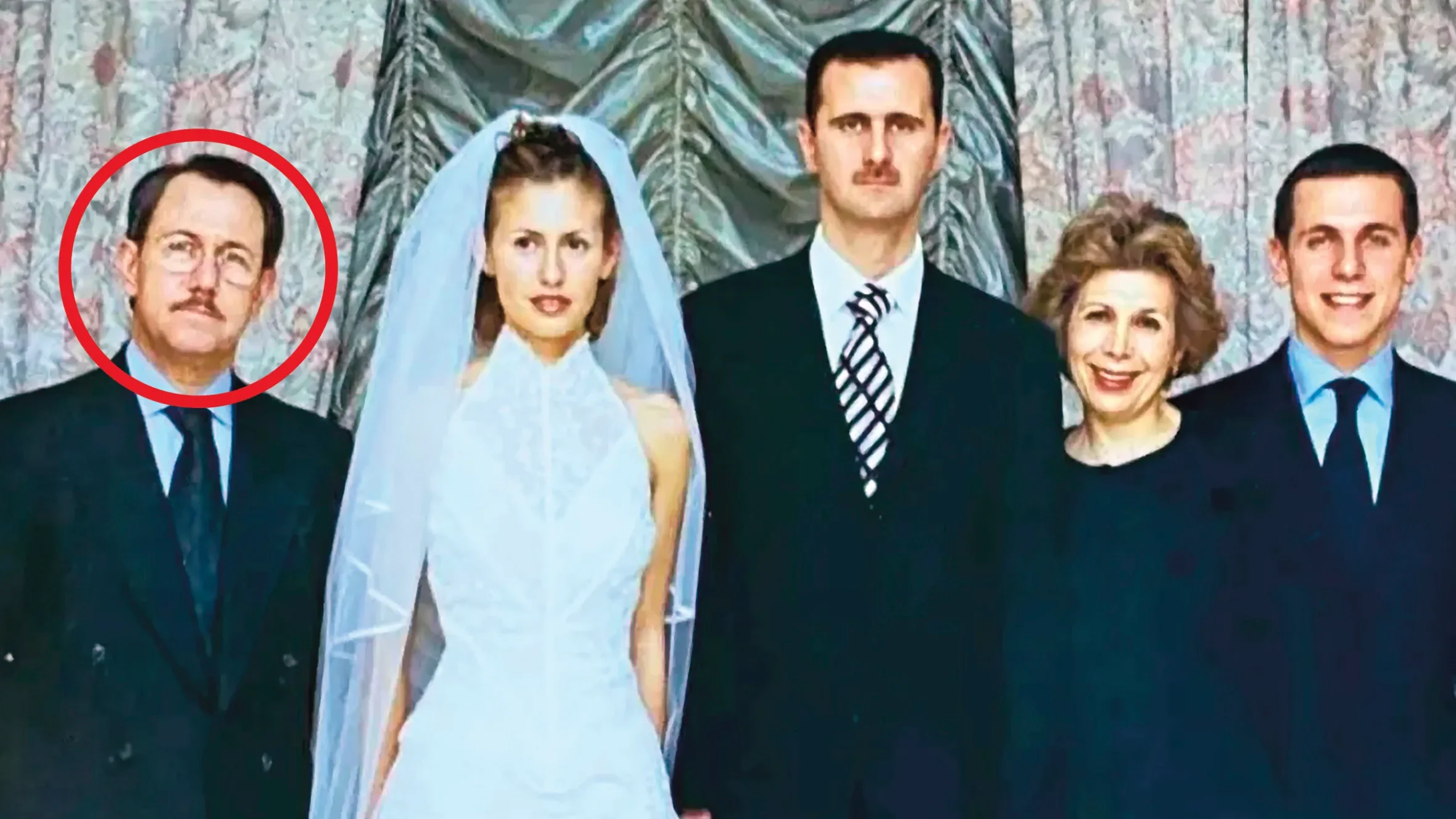
The Pariah of West London / Sunday Times Magazine
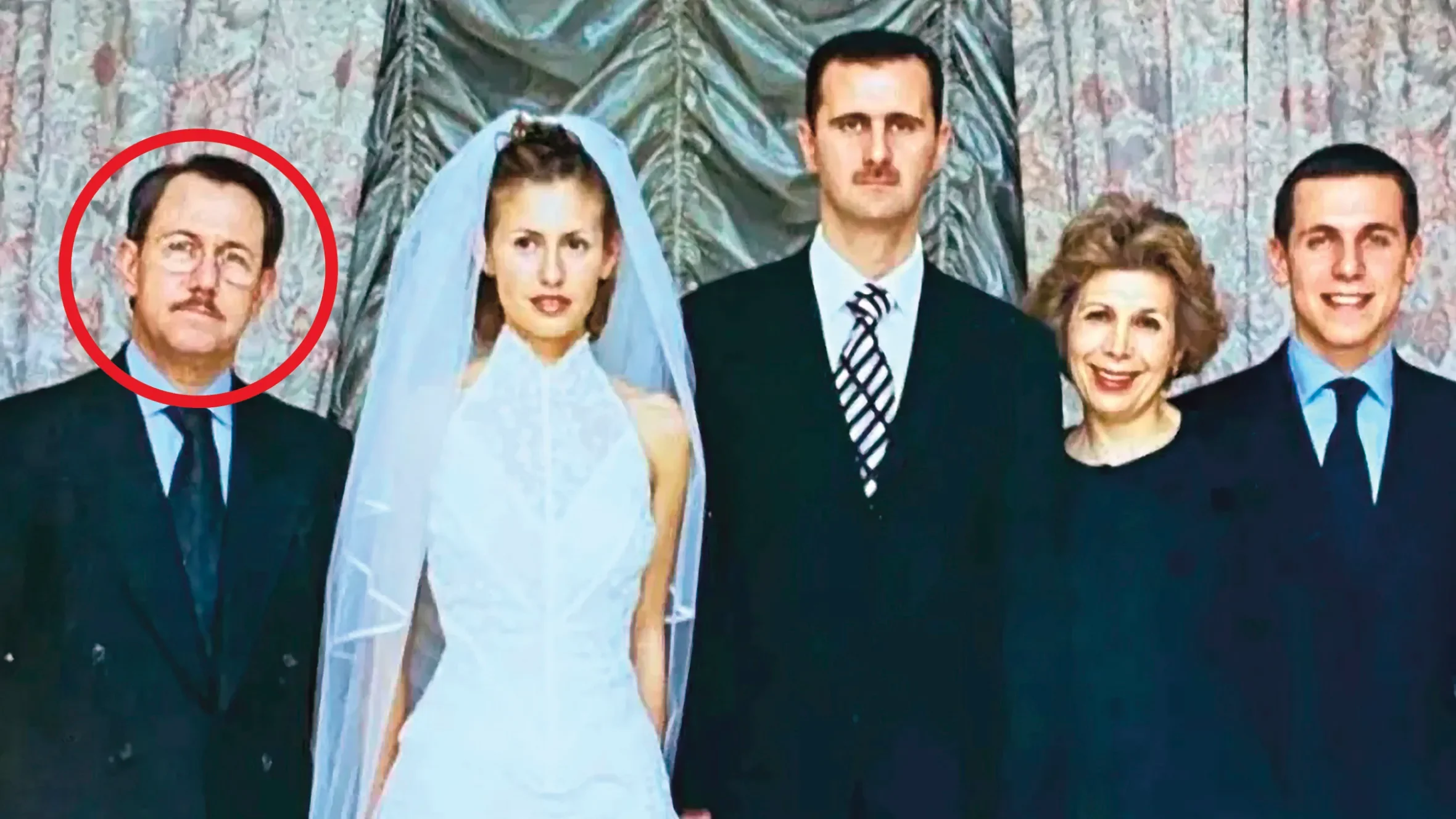
For an eminent Harley Street doctor and the father-in-law of an Arab dictator, Fawaz Akhras’s home in the West London district of North Acton is remarkably modest.
The brown pebble-dashed house is one of a terrace of four modest 1930s homes on a quiet suburban street abutting the A40. It has a shiny black front door and shades in the windows. Two roses and a honeysuckle grow in the front garden. A couple of regulation Ealing Council wheelie bins stand to one side. A small extension and loft room have been added to the rear. The run-down three-bedroom house next door was on sale last year for £700,000.
Only the uncommonly large satellite dish on the front wall suggests Akhras’s true status: his daughter, Asma, is the wife of Bashar Assad, Syria’s president until his spectacularly brutal and corrupt regime collapsed in December 2024 and the Assads fled to Moscow.
But this is only one of Akhras’s homes. The other is an entirely different beast. The Sunday Times can reveal that he owns what a visitor described as a “really massive” and luxurious modern villa with huge garden and swimming pool in an enclave for Syria’s elite called Yafour, just west of Damascus.
Sources say Akhras was in Damascus when opposition forces swept into the capital that momentous December night and toppled the regime after 13 years of bloody civil war. He fled to Russia with his daughter and son-in-law, but left his British passport behind in the chaos. Unable to acquire a new one in Moscow, he had to go to the British embassy in Dubai. He returned to Britain in May, since when he has lived all alone in Acton - a disgraced and widely reviled old man.
Once a highly respected cardiologist, Akhras mingled with London’s great and good following his daughter’s marriage to Assad in 2000. He was even invited to a state dinner at Windsor Castle. Today he is a pariah - a target of international sanctions who stands accused of aiding Assad’s murderous rule and enriching himself in the process.
What a fascinating story Akhras could tell if he chose to. How did he square his medical ethics with his apparent support for a regime that slaughtered 600,000 of its own citizens, used chemical weapons against its own people and reduced half Syria’s towns and cities to rubble?
Did he really support his son-in-law’s regime, or did he fear for the safety of his daughter and grandchildren if he condemned it? If he really enriched himself on the back of Syria’s unspeakable misery, why is he being allowed to live out his old age in London with such apparent impunity?
Or to put it more succinctly: was he venal, or essentially a decent man who found himself in an impossible situation and lost sight of right and wrong?
I sought to put those questions to Akhras directly. I wrote him a long, polite letter suggesting that he might want to tell his story now that the regime has fallen and his daughter’s family are exiled in Moscow, but I received no answer. I texted him with the same message, but again: no answer.
On a dull, grey Monday morning I knocked on his door and rang the bell several times. Again he did not answer even though his sleek blue Series 7 BMW - reputedly a gift from his son-in-law - was parked outside.
I then stood on the pavement, hidden from the house by a small tree. After a few minutes I heard the front door open and there was Akhras, perhaps thinking that a parcel had been left outside. As I approached I briefly glimpsed a frail, pale and startled-looking figure. “Dr Akhras,” I said. “I’m from the Sunday Times. Can I speak to you?” He slammed the door shut.
****
Fawaz Akhras was born in 1946 and raised, like many of his North Acton neighbours, as a Sunni Muslim in the Syrian city of Homs. He trained at Kings College Hospital in London in the 1970s, married Sahar Otri, a diplomat at the Syrian embassy, and settled in North Acton.
Akhras became a reputable cardiologist while he and his wife had three children - Firas, Asma and Eyad. He practised in Harley Street and at the private Cromwell Hospital in Kensington. He published numerous research papers. He won several awards. His website includes numerous glowing testimonials taken from an independent survey of his patients.
“Dr Akhras is a delight to visit. Not only has he taken great care of my health but is also lovely to speak to. It’s very rare to find a doctor who combines personal touches with outstanding quality of medical care,” wrote one.
“Dr Akhras has been my cardiologist for many years. He is always well informed, he explains things clearly, he inspires confidence and is a very pleasant man to meet,” wrote another.
Neighbours in Acton remember the Akhrases as a perfectly normal family. The parents would exchange pleasantries when they passed acquaintances in the street. Sahar went for walks and visited the mosque. The children played in the park.
Asma attended the local Church of England primary school, calling herself Emma. She went on to Queen’s College, a private girls’ school in Marylebone, then Kings College, London, where she studied computer science. She then embarked on a banking career with Deutsche Bank and J.P.Morgan, working in London, Paris and New York and specialising in mergers and acquisitions.
But everything changed when Bashar Assad arrived to study ophthalmology at the Western Eye Hospital in Marylebone in 1992 - a placement Akhras helped arrange. Asma knew the lanky son of the Syrian dictator, Hafez Assad, from childhood holidays in Syria, and now Sahar pushed them together. A former family friend called Sahar “a social climber”, and dismissed Akhras as “fundamentally a hen-pecked husband surrounded by women who have a far stronger character than him - both Asma and her mother. I think he’s a bit of a pushover.”
In 1994 Bashar unexpectedly became his father’s heir apparent when his older brother, Basil, was killed in a car crash. When Hafez died in 2000 Bashar succeeded him as president. Six months after that, he married Asma in a private ceremony even though he was an Alawite and she a Sunni.
Initially Bashar was seen as a reformer, and Asma as a breath of fresh air who embraced progressive causes - so much so that Vogue magazine famously described her as a ‘rose in the desert’ and ‘the freshest and most magnetic of first ladies’. But Acton’s Syrians, whose relatives in Syria had long been oppressed by their Alawite rulers, were appalled by the marriage. “He was a member of the Assad regime. Once an Assad, always an Assad,” said one. “People were shocked and disappointed,” said another.
Neighbours say Akhras and his wife became grander and “more stand-offish” after his daughter’s wedding. They acquired an Indonesian maid, while a Syrian embassy Mercedes took Sahar to work each day.
Akhras also became increasingly political. In 2003 he founded the British Syrian Society to improve relations with his son-in-law’s regime at a time when it was presenting itself as a modernising, liberalising force. He attracted former British ambassadors to its board, and flew British politicians to Damascus for conferences. He attended embassy receptions and gala dinners. He joined the advisory board of the Centre for Syrian Studies at St Andrew’s University. He became an unofficial conduit to Bashar.
In 2010 Alkhras and his wife received the ultimate stamp of establishment approval when the late Queen Elizabeth II and Duke of Edinburgh invited them to a state banquet for the Emir of Qatar at Windsor Castle. Their fellow guests included Charles, then Prince of Wales, David Cameron, the prime minister, and William Hague, the foreign secretary.
Five months later, the Sunni uprising erupted in Syria and Bashar Assad’s regime launched its bloody crackdown. Over the subsequent decade it killed, imprisoned, tortured and displaced millions of opponents; deployed the nerve gas Sarin, Scud missiles and barrel bombs against its own civilians; and deliberately shelled hospitals and schools - latterly with Russian and Iranian support. Nowhere suffered worse than Homs, Akhras’s native city.
It would have been extremely hard for Akhras publicly to condemn his son-in-law’s regime without endangering Asma and her three young children - Hafez, Zein and Kareem. Had he done so, his daughter would have had to cut all ties to him.
But his neighbours say he expressed no sympathy as their relatives were slaughtered, locked up or displaced. Worse, e-mails intercepted by a Syrian opposition group in 2012 showed that he was actively advising his daughter and son-in-law on how to manipulate the media and improve the regime’s image in the West.
No matter that the regime was flagrantly violating every fundamental value of Akhras’s profession and adopted country. In one e-mail he suggested 13 ways it could counter western criticism, including highlightling America’s use of torture in Iraq and the chaos that had followed other ‘Arab Spring’ uprisings. In another he suggested that the regime dismiss a Channel 4 documentary about its torturing of children as British propaganda designed to trigger a Syrian genocide. In a third he proposed the creation of an English-language television station “to enable us to address the world of our case in their own language and mentality (sic)”.
Approached for a comment by the Daily Telegraph, Akhras replied: “When the (2011) London riots burst out and David Cameron said he would get the army out, would you compare that to Homs?” Reminded that nobody had died in London, he replied: “We are not as sophisticated as the Metropolitan Police or Scotland Yard.”
When I telephoned Akhras following an egregious massacre of Assad’s opponents in 2012 he refused to comment. It was an important issue, I protested. “It’s an important issue to you,” replied the cardiologist who had dedicated his career to saving lives but now seemed bent on defending a regime that was killing people on an industrial scale.
The Akhrases’ Acton neighbours were further incensed when they spotted Sahar returning home with Harrods shopping bags, or the couple flying off to Damascus for several weeks at a time. “Everyone just cut ties,” said one. Syrians from further afield staged protests outside their house, paint bombing it and on one occasion smashing the front window.
The diplomatic invitations likewise dried up, and a string of senior British figures resigned from the British Syrian Society. “On a personal level, Fawaz is an agreeable, modest, understated individual and he is one of the world’s leading cardiologists,” one departing member, the former Conservative MP Richard Spring, said at the time. “I don’t know anyone who dislikes him. I have no idea what is going through his mind. I think he must be aghast.”
Malik al-Abdeh, a journalist who grew up directly across the street from Akhras and played with his children, offered an explanation for Fawaz’s stance.
“A lot of secular-minded Syrians feared the alternative to (Bashar’s) regime would be an Islamist regime, and therefore supporting the regime was their duty to civilisation,” he told me. “They fooled themselves into thinking, or genuinely believed, that the regime was Syria’s best shot at keeping Syria unified and stopping any Balkanisation and also maintaining its secular face. I think he’s one of those people.”
Akhras would have continued to believe that even after the regime slaughtered half a million of its own people, al-Abdeh added. “That’s the price you have to pay. That’s the way they would see it. This was a fight imposed on Syria by malicious external forces, including the US, Europe and Israel, that financed insurgent groups to bring Syria down, and therefore it’s their duty to fight back against the forces of evil. That’s the way they would justify it.”
A leading British expert on Syria, who declined to be named, offered another take on Akhras’s behaviour. “It’s like being involved with the mafia,” he said. “He was able to keep a little bit of distance before the war, just enough not to get compromised, but with the war it’s like all in. You don’t get to stay on the sidelines. You’re either with us or you’re not. There’s a premium on trust and loyalty. ‘You want to see your daughter and come to Damascus? You need to demonstrate you’re on side’.”
But Akhras allegedly went further than offering support: he actively cashed in on his daughter’s position.
In 2020 the US State Department imposed sanctions on him, his wife and their two sons, saying they had “accumulated their ill-gotten riches at the expense of the Syrian people”. In December 2024 the US Treasury imposed further sanctions on Akhras, saying he had “played a key role in facilitating financial and political support for Bashar al-Assad”.
Akhras called the sanctions “politically motivated”, insisting that “father-in-law is not a political position and I have never been politically involved, in any capacity, with the former Syrian government”.
His daughter certainly used her position massively to enrich herself. During the early years of the war, as the Syrian people suffered, Asma was secretly buying Christian Louboutin shoes, chandeliers, works of art and other luxuries, according to the same batch of leaked e-mails that exposed her father’s advisory role.
In 2020, despite being diagnosed with breast cancer, she largely appropriated the huge business empire of her husband’s cousin, Rami Makhlouf, after the two men fell out. She also ran the Syria Trust for Development, through which most of the international humanitarian aid to Syria was channelled, and doubtless took her cut.
Mike Pompeo, then US Secretary of State, called her “one of Syria’s most notorious war profiteers”. The Washington-based Tahrir Institute for Middle East Policy reported that“the Akhras family of Asma al-Assad have taken over most of the Syrian economy.” The Syrian Network for Human Rights reported: “Through a complex network of economic monopolies, forced donations from businessmen, and the deliberate exploitation of humanitarian resources, Asma al-Assad amassed a vast personal fortune.”
Akhras’s son, Firas, also got in on the act. He and a cousin ran a company called Takamol to which his brother-in-law’s regime awarded, in 2014, the exclusive right to run the electronic ‘smart card programme’ that it used to distribute subsidised food, fuel and other products to loyal areas of Syria. Takamol charged a fee for every transaction.
The financial case against Akhras himself is less clear - his luxury villa in Yafour notwithstanding. In 2011, the year the war began, he, his wife and Firas registered a company called National Medical Services in Damascus to build medical facilities and provide medical services in Syria. That may have been a laudable enterprise (in 2015, as the regime’s opponents were being massacred elsewhere in Syria, he opened a high end private medical centre in the middle class Damascus district of Dummar). Equally, in a deeply corrupt country, it would have created ample opportunity for graft, though no evidence has yet surfaced to suggest that Akhras used it for that.
The Assad regime fell nearly 18 months ago. Bashar, Asma and their three children fled into exile in Moscow, where they reportedly now live in one of the many luxury properties they had acquired there during Bashar’s presidency. Over the previous two years they had also airlifted around $250 million in cash to the Russian capital, according to a Financial Times investigation.
Since then the family has scarcely been seen save for a single video posted on Telegram by Hafez, the oldest son, and some social media photos of a lavish 22nd birthday party that the deposed dictator threw for Zein, his daughter, and of her graduation. The Assads are closely guarded. They have been told not to make any public statements or appearances, and Russia’s state-run media has been warned off.
Meanwhile Akhras, now 79, lives a lonely existence in his Acton house - having chosen the wrong side and lost almost everything.
The once eminent cardiologist no longer works: he has not been struck off the General Medical Council’s register, but the US sanctions make it impossible for him to use credit cards and conduct business.
Akhras faces no criminal charges in the UK, and neither the Foreign nor Home Offices would discuss his case, but his good name has been destroyed and he will be associated with one of the world’s nastiest regimes for the rest of his days.
His Yafour villa was almost certainly looted after Bashar’s regime fell, and has gone forever. A source in Damascus says the new government has seized his Dummar medical centre. The British Syrian Society is defunct.
The whereabouts of his wife and sons are unknown, but his exiled daughter and three grandchildren live 2,000 miles away (there is an unconfirmed rumour that they have been stripped of their British citizenship). Moreover Asma is now said to be battling acute myeloid leukemia.
Akhras is now a pariah in his own neighbourhood. Apart from his younger son, Eyad, who spent a few days with him earlier this year, he has no visitors. He seldom leaves his house, though he occasionally dines with fellow apologists for the Bashar regime. It is unclear whether the British government has provided him with a new passport to replace the one he left behind in that Syrian maelstrom.
I asked residents of North Acton with relatives in Syria whether they felt sorry for him. “I feel sorry for the Syrian people, not him,” one replied tartly. “He’s pissed in his own pot. He’s brought it upon himself.”