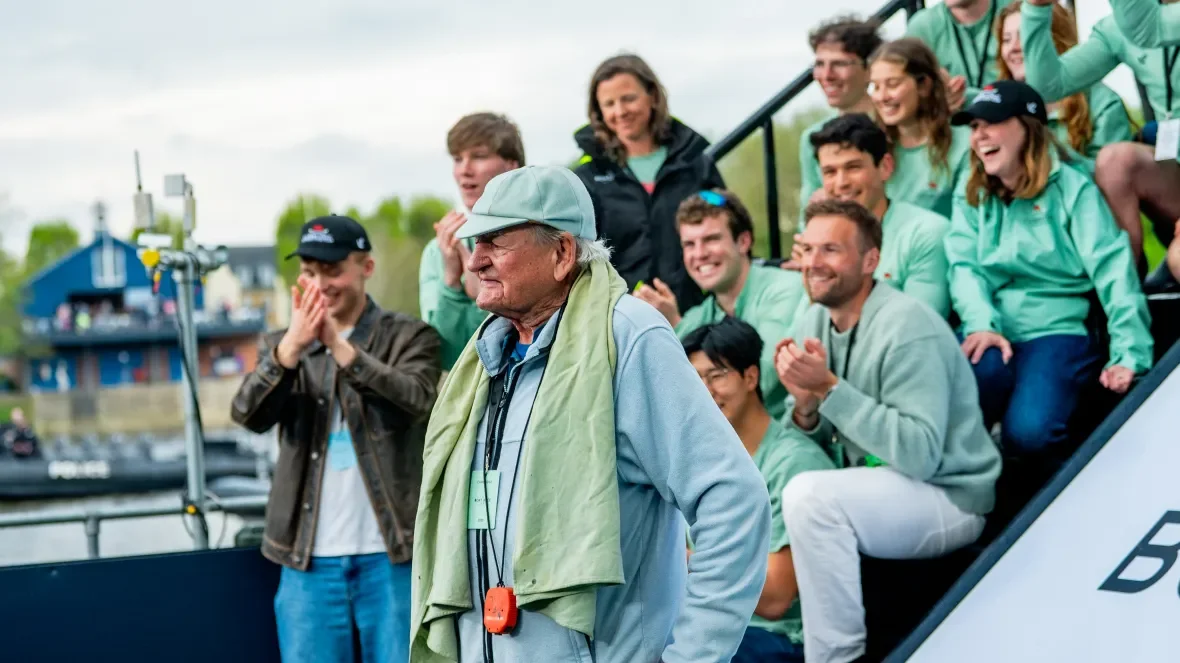
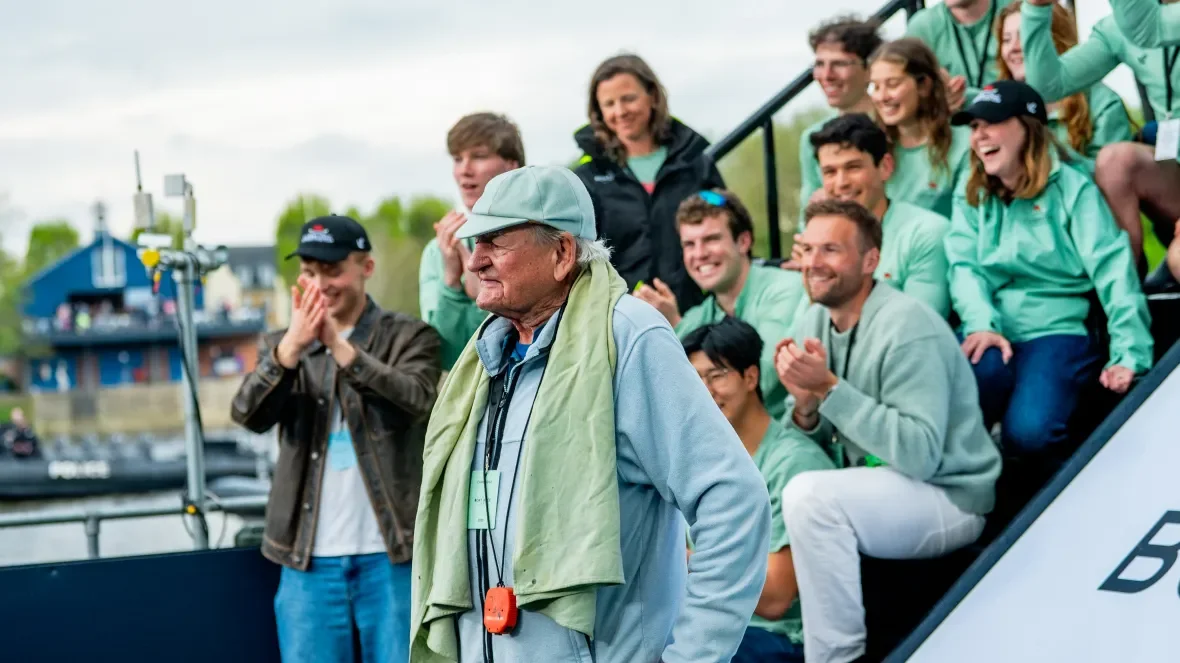
Donald Legget / The Times
In Donald Legget’s six decades as a rowing coach he achieved legendary status on two counts. He was revered by the many hundreds he taught at Cambridge, Radley College, St Paul’s and other clubs and schools. He was also renowned for his extraordinarily rough tongue.
A large, heavy man, he laced his remarks with profanities and racial taunts — most unrepeatable. He gave his charges teasing nicknames: “the bloody Egyptian”, the “Turk”. He referred to women’s rowing as “assisted drifting”. Boys from posh public schools were “tuck box”, the rest “grammar grub”. The French were “the people who nearly lost us two bloody world wars”, the Canadians “colonials”. He told one young rower: “There’s a piece of shit on the end of your oar.” When the boy looked at his blade, he added: “No, the other end.” He told another: “You couldn’t pull the skin off a rice pudding.” Biking along a towpath beside a boat, he ran into a walker and asked: “Are you f***ing blind?” The man was.
Some were offended, but not those who knew him. They realised he belonged to an age before political correctness. They understood that he never meant what he said unkindly, and that not being taunted was worse. They knew that behind the bluster was a man who cared deeply for his many protégés: a “Mr Chips” of rowing. They also knew that he was an extraordinarily gifted coach who dedicated his life to the sport he loved.
Legget was never a head coach. He was far too disorganised, and incapable of delivering an inspiring pep talk. He enjoyed a drink or two or three (he liked to insist that his surname was spelt with “two Gs and one T — like the drink”). One former colleague described him as “the only person I know who can single-handedly destroy a brand-new hire car without actually hitting anything. An Amsterdam street disappeared in a vast cloud of billowing blue smoke as the revs went off the counter and the engine summarily blew up.”
His great gift was his “eye”, his ability instantly to assess a crew’s potential, to spot tiny technical flaws in a boat’s balance or a rower’s stroke, to explain the tweaks that would enhance a crew’s rhythm and earn it those precious extra seconds. He was a “tideway guru” who knew the bends and currents of the Boat Race course inside out, and exactly where a cox should steer at any particular point of the river: “Aim for the second lamppost on the left.”
His social views may have been outdated, but he kept up with all the latest rowing technology to gain a few more seconds through better materials or telemetry. During the Cold War, when East Germany was a force to be reckoned with, he taught himself rudimentary German so he could read its rowing magazines and garner its secrets. He also had an encyclopaedic knowledge of rowing. “Nostalgia comes easily to a man who has spent his life teaching people to go backwards,” Patrick Kidd once wrote in The Times.
Legget’s reward lay less in his rowers’ many triumphs at the Olympics, the Boat Race, the Henley Royal Regatta and countless other races around the world; it lay in the sheer joy of the sport, the individuals he inspired and the lasting friendships he made.
All his life he suffered from depression. Rowing was how he coped. “You’ve got to fight your way out of bed in the morning and do something and have a purpose in life,” he told a New Zealand radio station. “The huge purpose I have is coaching rowing.”
Donald Ferguson Legget was born in Heswall on the Wirral in 1942, the oldest of three children of Donald and Winifred Legget. His father ran a company that painted refineries, bridges and large industrial structures. From Mostyn House, a now-defunct prep school in Cheshire, he won an exhibition to Radley, where he fell in love with rowing and became head of boats.
A second exhibition took him to Trinity Hall, Cambridge, to read classics, though he was thrown off the course because he was preoccupied with rowing. The law department took him on instead, and he became a member of the light blue Cambridge crews that lost the Boat Race in 1963 and won it in 1964. In the second of those races he was dubbed “HBE”, Heaviest Bow Ever.
After graduating he became a less than enthusiastic articled clerk with the law firm Allen & Overy, and captained the venerable Leander rowing club. But he had a breakdown, underwent experimental electro-convulsive therapy and suffered from depression for the rest of his life. After a year of “moping around”, he returned to Mostyn House as a classics teacher, but did not enjoy that either.
Salvation came in 1968 when he was invited to join Cambridge University Boat Club’s coaching team. He remained there for 58 years while simultaneously coaching at various schools. Coaches in those days were unpaid, so Legget made ends meet by selling sports clothing to schools. A lifelong bachelor, he lived frugally and somewhat chaotically in a flat in Weybridge, Surrey, where he also sang in a male voice choir. Extraordinarily, a photo of him in cap and scarf featured in The Official Sloane Ranger Diary of 1983 with the caption “Modelling the Boat Race style”.
In 1996, in addition to coaching at Cambridge, he was invited to join the coaching team at Radley, his alma mater. The warden, or headmaster, aware of his reputation, stipulated that he should pay a £5 penalty every time he swore. During his years there Radley enjoyed unprecedented success, winning three national titles and the prestigious Princess Elizabeth Challenge Cup at Henley. But on several occasions his lack of verbal restraint got him into what colleagues described as “scrapes”, and he was let go after falling out with a new head coach. He was deeply hurt.
One Radley parent was so outraged that he funded Legget’s stipend for two years when he was subsequently taken on by St Paul’s School in London as a part-time coach. He did so in the hope that St Paul’s would beat Radley, and it did. Indeed, with Legget’s help, St Paul’s won the Princess Elizabeth Challenge Cup four times in ten years and produced one of the fastest school crews ever.
But again there were “scrapes”. Legget once dismissed the Barnes Bridge Ladies Rowing Club, the organisers of the Pairs Head of the River race on the Thames, as “bloody useless”. The ladies threatened to ban St Paul’s from future races until he apologised.
Legget remained an adviser to St Paul’s until last year, by which time he was 83, having difficulty getting in and out of a launch and occasionally falling asleep in mid-river. Even then he continued coaching at Great Marlow School in Buckinghamshire, but he fell off his electric bike during a training session, broke his hip and never really recovered.
Donald Ferguson Legget, rowing coach, was born on June 16, 1942. He died on July 9, 2026, aged 84