Why Belfast Still Needs ‘Peace Walls’ / Sunday Times Magazine 11/2025
Patsy Canavan well remembers the night of August 15 1969 when a loyalist mob rampaged along Bombay Street, a short row of terraced homes where the Catholic Falls Road and Protestant Shankill Road start to diverge in West Belfast.
The rioters terrorised the street’s Catholic families, burned their houses and drove them out. Gerald McAuley, a 15-year-old member of the IRA’s youth wing, was shot dead as he helped his neighbours flee. The British army, newly arrived in Northern Ireland, stood by, powerless to intervene as the sectarian fury of what became known as the Troubles erupted in Belfast.
“We were really frightened,” recalls Canavan, who was 14 at the time. “The men stayed but we went. Our house was gutted. Everything was burned, so it was. We had no clothes, no nothing…We got our wee dog out, but it had to be put down it was so frightened.”
She and her three siblings took refuge in a nearby church hall. Her mother, Rita, who was pregnant with her fifth child, lost her hospital job because she failed to go to work in the following days. The Canavans spent that winter in an unheated caravan, but returned to Bombay Street the following year after their house was restored by the city council.
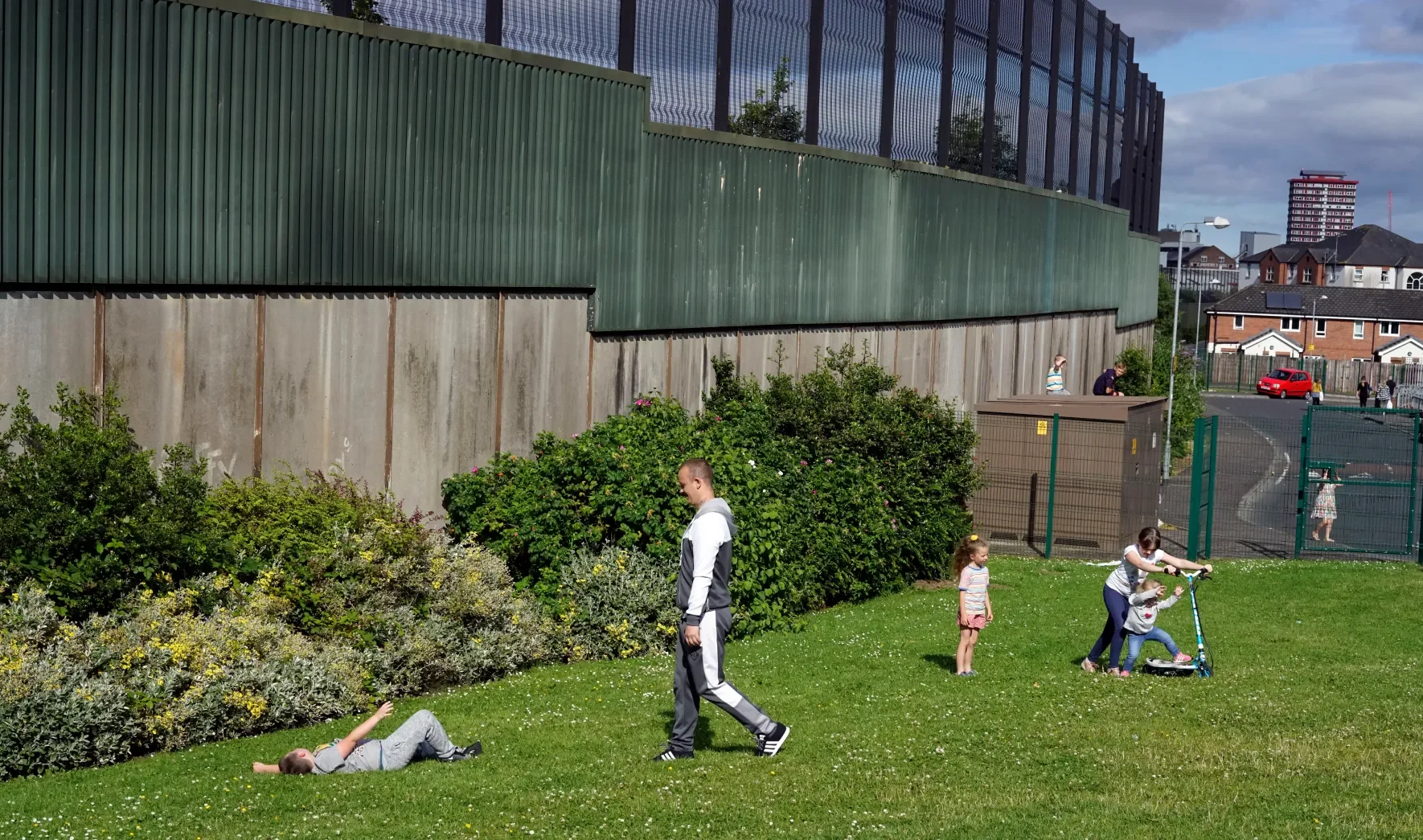
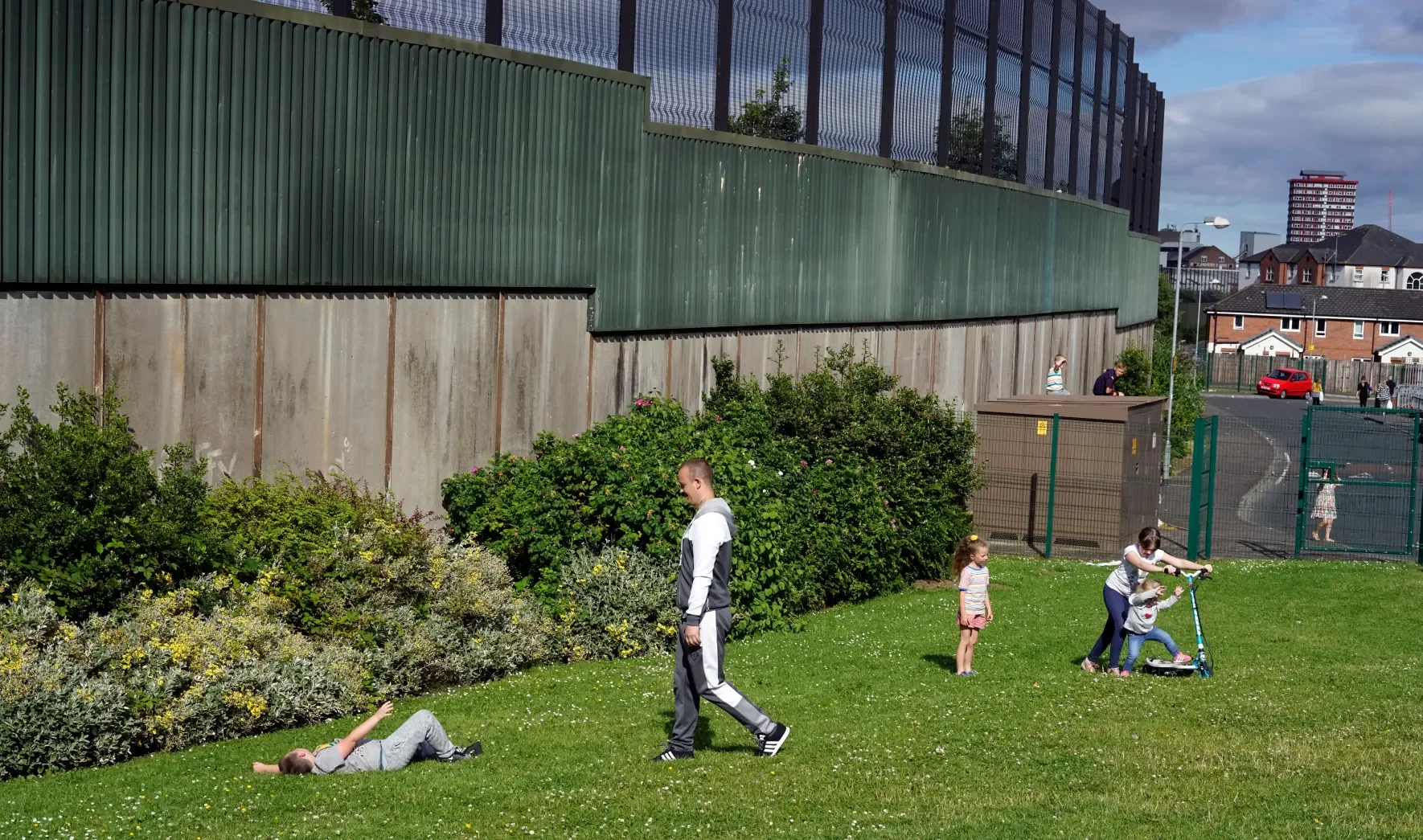
By then the army had erected a barbed wire barrier between the Shankill and the Falls, and over the decades that barrier has morphed into a monstrous wall of concrete, sheet metal and wire mesh that runs 800 metres along Cupar Way, towering over the houses on the north side of Bombay Street.
Moreover the small back gardens of those houses are entirely covered in metal cages to protect them from the stones, bricks, golf balls, paint and petrol bombs that loyalists still manage to hurl over the wall at times of tension.
It has grown “bigger and bigger and bigger”, says Canavan, now 70, as she sits in her neat front room with a picture of the Virgin Mary above the settee. “The more trouble there was, the more they built it up.”
But here is the surprising thing. When I ask if she would like it dismantled, she replies: “No, definitely not. We want it higher! They can still throw things over.”
****
When that original barbed wire barrier was first erected, James Chichester Clark, Northern Ireland’s prime minister, insisted: “There should be no question of the peace line becoming permanent.”
Sir Ian Freeland, the army’s commander, likewise promised that "this will be a very temporary affair. We will not have a Berlin Wall or anything like that in this city."
But the barbed wire barrier could not stop missiles or snipers’ bullets, and it was soon replaced by a higher wall of corrugated iron.
Then, in 1971, a secret report for Northern Ireland’s government recommended the erection of a “cordon sanitaire” between West Belfast’s Catholic and Protestant communities, even though “it is an ugly thing to see a barrier of this kind in the UK…it emphasises and institutionalises divisions…the abnormal can come to be taken for granted and the search for fundamental solutions set aside for another day.”
Anthony Hewins, the British government’s representative, was the sole dissenter. He decried “proposals that the divisions in the community should be accepted as a feature of life which must inevitably persist for a hundred years or more. This seems a counsel of despair.”
Hewins’ warning proved all too prescient. More than half a century later, that initial barbed wire barrier has not only grown into a vast and hideous wall, but spawned scores of others.
Fully 27 years after the Good Friday Agreement (GFA) curtailed the Troubles, they still snake through the former killing fields of west, north and east Belfast, dividing and disfiguring the city in a manner unthinkable anywhere else in the United Kingdom.
Exactly how many there are is hard to say. They do not appear on maps. They fall under the remit of different agencies including, primarily, the Department of Justice and the Northern Ireland Housing Executive. And there is no precise definition of what constitutes a ‘peace wall’.
The semi-official total is 60-odd, stretching more than 20 miles along the so-called ‘interfaces’ between loyalist (Protestant) and nationalist or republican (Catholic) communities. But a comprehensive survey by the Belfast Interface Project (BIP) in 2017 identified and photographed 97, plus 19 more in Londonderry, Portadown and Lurgan.
Certainly several have been removed in recent years, but Paul Smith, BIP’s affable project manager, still reckons there are as many now as when the GFA was signed in 1998.
They are variously made of brick, concrete, steel, wire mesh or spiked palisade railings. A few have gates which are open by day but closed at night, either manually or automatically, and monitored by security cameras in case of trouble. It is a long way round if locals arrive after the gates have closed, but they know the timings by heart. “It’s like putting your bins out,” said one.
The best known is the Cupar Way wall, which has now stood twice as long as the Berlin Wall and become a rather grotesque tourist attraction. It is daubed with thousands of messages, including one written by the Dalai Lama in 2000: 'Open you arms to change, but don;t let go of your values'.
Close by is the ‘International Wall’, which is covered in republican murals celebrating fellow ‘freedom fighters’ like the Palestinians, Sri Lanka’s Tamil rebels and Nelson Mandela. The longest is probably the ‘million-brick wall’ which slices through the Springmartin and Springfield areas of outer West Belfast.
Some ‘walls’ are hidden behind rows of houses, concealed behind trees and bushes, or incorporated into shopping centres and business parks in what Belfast calls ‘defensive architecture’. In East Belfast I found a billowing wire net, around 15 metres high, that was erected in the grounds of St Matthew’s Church as recently as 2013 to prevent loyalists throwing missiles into a small Catholic enclave.
But whatever their form they are still barriers designed to keep working-class Catholic and Protestant communities apart, and their continued existence more than a quarter of a century after the GFA represents a singular political failure.
Back in 2013 the G8 summit of developed nations was held near Enniskillen in County Fermanagh. Under pressure from the British, American and Irish governments to create an optimistic backdrop, Peter Robinson and Martin McGuinness, then Northern Ireland’s First and Deputy First Ministers, announced a target of removing all the ‘peace walls’ by 2023 with - crucially - community consent.
The executive never came close to meeting that target. It found that removing the walls was far, far harder than building them, and Bombay Street shows why.
****
Things are better now than they used to be, Patsy Canavan concedes, but “they (the loyalists) still throw things over” the wall at the times of tension which periodically flare up in Northern Ireland. The spark could be a sectarian dispute over flags or parades, or a Glasgow Celtic versus Rangers football match, or simply a Saturday night’s ‘recreational rioting’.
Canavan’s siblings agree with her - “I’d like it down, but you’d be scared of them attacking you,” says her brother, Seamus AGE. And that view is, I discovered, widely shared on both sides of the city’s sectarian divide.
Three miles away, Cluan Place is perhaps the Protestant mirror-image of Bombay Street - an L-shaped cul-de-sac of around 30 homes divided from the nationalist Short Strand area of East Belfast by another hideous cage of brick, steel sheeting and wire mesh topped by security cameras.
There I’m greeted by a sign declaring: ‘Welcome to Loyalist Cluan Place. Unbowed. Unbroken’. In a similar vein, a gable end mural proclaims: “20 Families Intimidated Out By Sinn Fein/IRA…Still Loyalist. No Surrender’. That is a reference to the sustained assault to which Cluan Place was subjected by its nationalist neighbours in 2002.
Residents vividly recall the hail of paint and pipe bombs, bricks, ball bearings and jars of food that rained down on them day after day, not to mention bullets. Several were injured. The authorities responded by raising the wall still higher and installing bullet-proof windows in the homes.
Recent years have been calmer, but Cluan Place - like Bombay Street - has grown accustomed to its ‘peace wall’ and emphatically does not want it removed.
“Definitely not - not the way things are. It’s quiet enough now, but you never know when things are going to flare up,” Ruth Stevenson, a great-grandmother sporting a bright yellow fleece, tells me as she leaves to go shopping. “It wouldn’t be worth the aggro,” her daughter, Janet, agrees.
And so it goes on. Short Strand is itself a small, walled-in enclave of perhaps 3,000 Catholic residents ringed by predominantly Protestant East Belfast and overshadowed by the great yellow cranes of Harland and Wolff.
Just as it besieged Cluan Place, so it too was besieged by its loyalist neighbours during sustained clashes, replete with gun battles, in 2002. Some homes near its perimeter now have reinforced tiles, windowless upper floors and window grilles to protect them from missiles.
“I’d love to see it come down tomorrow,” Daniel Walsh, 39, an electrician, says of the concrete and steel mesh barrier overshadowing his home in Bryson Street. But, he adds: “That’s an unpopular position in this street. People see it as a comfort blanket. The majority would say no.”
A comprehensive Ipsos MORI survey for Northern Ireland’s Justice Department in 2019 found that just 16 per cent of those living near ‘peace walls’ wanted them dismantled immediately, while 56 per cent wanted them left as they are or removed some time in the future. Nearly 80 per cent feared removing them would spur sectarian violence and anti-social behaviour. Half worried the police would be unable to keep order.
This fear of the ‘other side’ is less surprising than it sounds to outsiders. The Troubles cast a very long shadow over Northern Ireland. It remains a deeply traumatised province, especially in working class estates where so much of the fighting occurred.
Everyone suffered in different ways. Commemorative murals adorn a thousand gable ends. “People’s memories of what happened 30 or 40 years ago are still raw,” says Jonny Byrne, Ulster University’s ‘peace wall’ expert. “People died in these areas. People were hurt, and it’s still there.”
The province also remains deeply divided. More than 90 per cent of Belfast’s housing estates and schools remain segregated. There has been no peace and reconciliation process between its two tribes, and scant justice or accountability for the atrocities committed. Here the past lingers, wounds fester, and grievances are passed down to successive generations.
The 2019 survey found that a remarkable 76 per cent of those living near peace walls seldom, if ever, interacted with those on the other side.
Kelly Hart, 46, another Cluan Place resident, says that if she ventured into Short Strand “I’d be carried out in a box”. Patsy Canavan will not go into the Shankill, just across the wall from Bombay Street, because, she says, “they would kill you”.
Of Canavan’s siblings only Mary has spent time in the Shankill because she worked there as a carer while concealing her Catholic background. “The saddest part of it is they’re just like us,” she notes perceptively. Across Belfast, the ‘peace walls’ are flanked on both sides, Protestant and Catholic, by some of the UK’s most socially and economically deprived areas.
****
There is a second reason - less openly acknowledged - why so many of the ‘peace walls’ still stand: they prevent Catholics encroaching on the territory of a loyalist population that regarded the GFA as a defeat and now feels beleaguered.
The 2021 census showed Catholics outnumbering Protestants for the first time in Northern Ireland. In Belfast, Catholic areas are generally younger and fuller, Protestant areas older and emptier. While the Falls now has a housing shortage, the Shankill’s population has fallen from around 80,000 in the 1960s to 18,000 now - a collapse aided by a mass exodus of Protestants to satellite towns in the violent 1980s.
That demographic trend is a recipe for loyalist paranoia. It fuels what a 2017 Ulster University report called "concerns in the Protestant communities that if the peace walls come down then Catholic mobility will begin to extend beyond the boundary of the former peace walls into these Protestant communities, further diluting the diminishing Protestant population and leading to its eventual disappearance”.
That explains why the 2019 Ipsos Mori survey found many more Protestants (37 per cent) than Catholics (12 per cent) agreeing that ‘without peace walls our community would disappear’. It is why loyalist politicians - fearful of having their electoral base diluted - tend to resist initiatives to remove them. And it is why residents like Kelly Hart vow never to leave Cluan Place.
“They (Short Strand’s Catholics) want this street so bad. They’ve wanted it for years and years and years,” she says. Hart’s mother, Roberta, 72, adds as she stands on her doorstep: “It would be like being defeated. They want to take this street over. They’ve always said that.”
That conspicuous lack of ‘community consent’ for removing the walls could perhaps be overcome by strong political leadership, but of that commodity there is precious little.
There is no ‘Minister for Dismantling Walls’ to drive the process forward, no latter-day Ronald Reagan demanding: “Tear this wall down!”. In such a polarised province politicians see little electoral advantage in promoting reconciliation, or putting the common good above narrow sectarian interests. They do better by playing the ‘green’ or ‘orange’ card, and being seen to defend their own people.
No other agency seems keen to take the lead. The Department of Justice, which is responsible for the majority of the walls, has an ‘interfaces team’ of just four people, with an annual budget of less than £1 million, and its remit includes the maintenance of the walls as well as encouraging their dismantling.
The Police Service of Northern Ireland has no great interest in removing barriers that make it easier to maintain order. Paramilitary groups, which have now morphed into criminal gangs (vis the BBC drama ‘Blue Lights’), oppose the dismantling of the walls because that would dilute the powerful hold they still enjoy over Belfast’s working class estates.
Of that ten-year target for removing all the walls, Ulster University’s Jonny Byrne says: “We basically had this policy with no funding behind it, no strategy and no understanding of how complex the issue really was.”
Thus progress towards dismantling the walls is incremental at best, and even seemingly minor breakthroughs are hailed as great successes.
Early one morning I visited Alexandra Park in North Belfast - a notorious patchwork quilt of sectarian enclaves where nearly a fifth of the Troubles’ 3,600 victims died.
In 1994 the pleasant Victorian park, replete with fine avenues of trees, a lake and stream, was cut in two by a hideous steel peace wall, three metres high, to separate the loyalists of Tigers Bay from the nationalists of Antrim Road. It thereby gained the dubious distinction of being the only park in Europe divided by a wall, with separate playgrounds for Catholic and Protestant children.
It took two years of laborious door-knocking and trust-building, co-option and persuasion, but in 2011 local activists finally succeeded in opening a gate in the wall so people could stroll through - at least in daytime. It still closes at 10.00pm.
Nowhere else in the UK would opening a pedestrian gate in a park be considered remarkable, but it was here. Sylvia Gordon, the diminutive but strong-willed woman who inspired that initiative, calls it “an act of historical symbolism” that shows “people reaching out to each other and engaging in a different way”.
President Obama agreed. In a speech to young people in Belfast in 2013, he declared: “As long as more walls stand, we will need more people like Sylvia. We’ll need more of you, young people, who imagine the world as it should be; who knock down walls; who knock down barriers; who imagine something different and have the courage to make it happen.”
Rab McCallum, a former IRA man who served 12 years in the Maze prison, showed me another ‘success’: the dismantling of an impenetrable double barrier that had for 40 years blocked Flax Street, a thoroughfare between Catholic Ardoyne and Protestant Crumlin Road which had previously served as a conduit for paramilitaries launching sectarian attacks in North Belfast. The barrier was replaced in 2022 by a single see-through gate of steel railings that is open during daytime and automatically closes at night.
McCallum was a key player in that initiative - as ex-combatants so often are. He tells me it took ten years to build the necessary consensus in the face of loyalist concerns. “It was territorial,” he says. “It was a general sense that ‘they want our houses. That’s what they are looking for. It’s our houses and that’s the way it’s always been here’.”
Flax Street has now been open three years with little serious trouble.
****
The Good Friday Agreement has unquestionably transformed Northern Ireland from the drab province where I lived for two years in the late 1990s.
The killing has largely stopped. Soldiers no longer speed around in slate-grey armoured Land Rovers. Police stations, courts and other public buildings are no longer shrouded in protective steel cages. Belfast’s vibrant city centre is full of tourists, smart restaurants, fancy hotels and gleaming new buildings.
Polls show younger people, in particular, are eager than their parents’ generation to see the walls removed and reject the old sectarianism
“Kids around here just have no issue. They just don’t even know what a peace wall is,” says Catriona O’Neill, 31, a youth worker from Duncairn Gardens, an ‘interface’ between the republican New Lodge and loyalist Tiger’s Bay districts of North Belfast. “It’s the older people holding on to past experiences. I would hope (the walls) will come down in time. I do think the separation keeps it going and communities won’t come together and bond if they’re still there.”
But the survival of the ill-named ‘peace walls’ - or what McCallum calls “segregation barriers”- serves as a stark reminder of how far the province has yet to go.
The GFA has curtailed the violence, but it has not yet generated true peace. The walls keep Protestants and Catholics safe within their own communities, but prevent the sort of coming together, the healing, that would remove their need for protection in the first place.
It is as if the conflict has been frozen in place with the help of concrete and steel, but not yet resolved.
“It’s like purgatory - stuck,” Jonny Byrne says. “We have peace now, but we haven’t done anything about it. We haven’t moved on from the GFA,” laments Smith. Time and again, he says, people tell him that “maybe my grandchildren or great-grandchildren will take the walls down, but we need them for the moment”.
Flying back to London, I remember how, on a previous visit, I had met a former loyalist paramilitary named Jim beside the Cupar Way wall. “Before this comes down,” he told me, “the walls in people’s heads need to come down.”