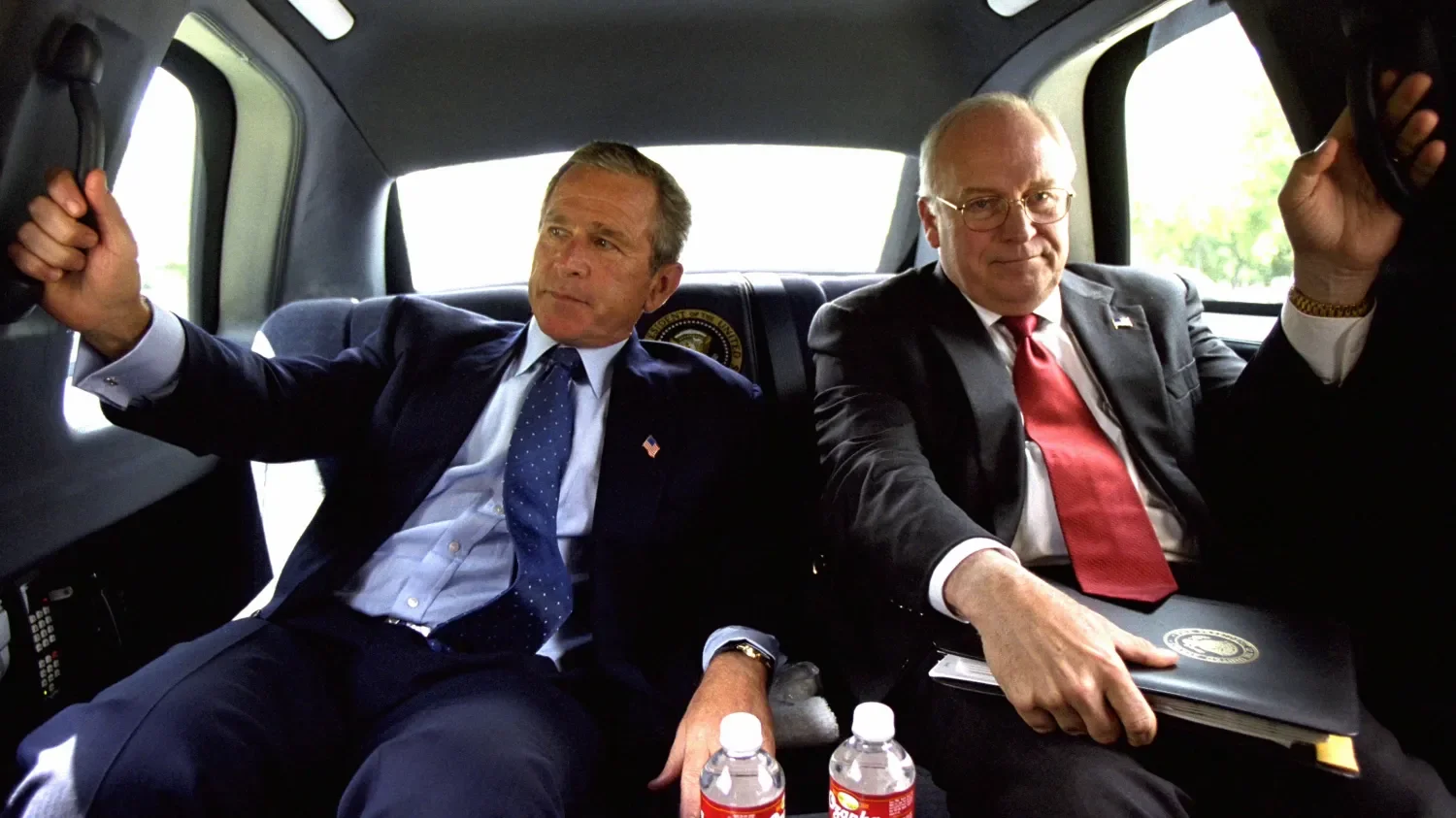
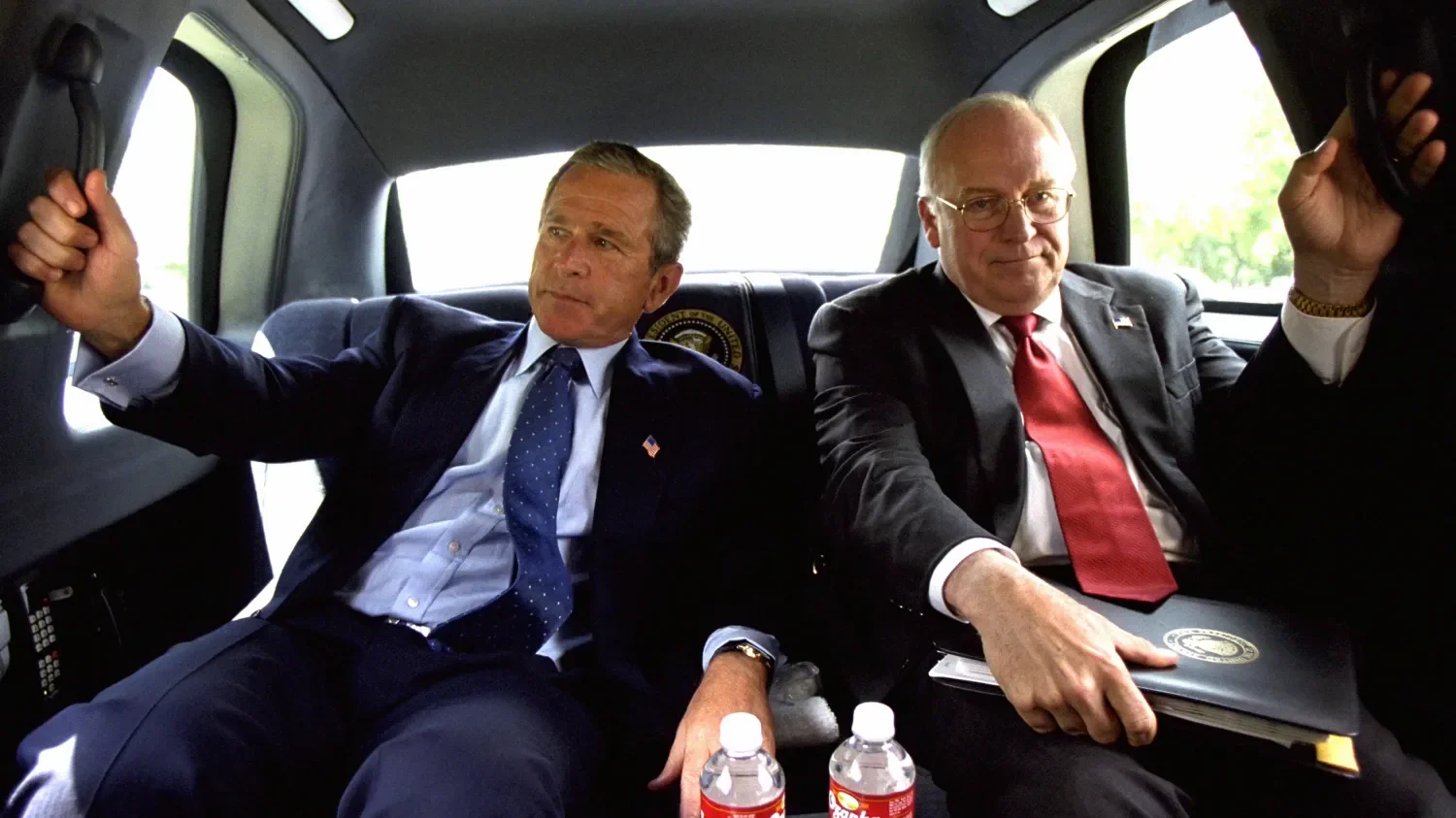
Richard Cheney / The Times
Dick Cheney was never happier than when he was fly-fishing in the rivers of his mountainous home state of Wyoming — matching his wits against the trout and salmon, casting his fly with pinpoint precision, knowing exactly when to strike.
It was an occupation that required stealth, patience and cunning — the very attributes that made Cheney the most powerful and controversial vice-president in modern US history.
Critics would contend that Cheney played George W Bush a bit like a fish during their first four years together in the White House, although he was increasingly marginalised in the second term. As much as anyone, it was Bush’s wily, arch-conservative deputy who persuaded him to invade Iraq, to incarcerate terrorist suspects in Guantanamo Bay while subjecting them to what most people would describe as torture, and to authorise the warrantless electronic surveillance of millions of US citizens.
Once, early in their first term, Cheney was asked how many times he had met privately with the president. “Let me see — three, four, five, six, seven times,” he replied. After pausing for effect, he added with his characteristic dry humour: “Today.”
Cheney was revered by hardline Republicans, but loathed by more moderate Americans. A taciturn, secretive man with a crooked and enigmatic half-grin, he came to be seen as a somewhat sinister éminence grise, a powerful but malign influence on the president. He left office with the lowest approval ratings of any modern vice-president.
Yet Cheney was unabashed. He cared nothing about popularity, only about history’s verdict. He left office with no regrets about the course he had taken, even though Iraq was in turmoil, America’s economy and international standing were in dire shape, and the so-called War on Terror had succeeded only in making the world seem less secure.
His thinking had been dramatically affected by the 9/11 attacks in 2001, the first year of the Bush administration. If terrorists armed merely with box cutters could wreak such havoc, what could they do if they acquired nuclear or chemical weapons, he asked. Saddam Hussein, with that huge supposed stockpile of weapons of mass destruction, had to go. And if waterboarding a few al-Qaeda suspects was required to ensure America’s security, so be it. The fact that there had been no further terrorist attacks on US soil since 9/11 was, for him, justification enough.
“In the fight against terrorism there is no middle ground, and half-measures keep you half-exposed,” Cheney declared in one of several angry diatribes he later delivered against what he regarded as President Obama’s pusillanimity on issues of national security.
Richard Bruce Cheney was born in Lincoln, Nebraska, in 1941, the son of parents who had emerged from the Great Depression as die-hard Democrats. In 1954 his father, a soil conservation expert with the Department of Agriculture, was transferred to Casper, Wyoming, where Cheney developed his lifelong passion for hunting and fishing.
At high school he was the star football player and a perfect match for Lynne Vincent, a champion baton twirler and homecoming queen, whom he later married and who survives him with their two daughters. She went on to become a prominent public figure in her own right, chairing the National Endowment for the Humanities, writing numerous books and appearing as a conservative talk-show host on CNN.
The younger of the couple’s daughters, Mary, is gay, and Cheney’s support for gay marriage was about the only liberal position he took. The elder, Liz, worked in the state department during the Bush administration and ran for the Senate from Wyoming in 2013, but she withdrew from the race after a public spat over gay marriage with her sister. She served as the US Representative for Wyoming’s at-large congressional district. In 2019 she took to social media to denounce Christian Bale, the actor who played her father in the acclaimed Hollywood biopic Vice. When, in an acceptance speech at the Golden Globes, Bale said: “Thank you to Satan for giving me inspiration on how to play this role”, she posted an article citing Bale’s arrest for allegedly assaulting his mother and sister with the words: “Satan probably inspired him to do this, too.”
She also became one of the most vocal Republican critics of Donald Trump, serving on the House select committee investigating the January 6 attack on the Capitol.
In 1959 Dick Cheney won a scholarship to Yale. It was the first time he had been east of Chicago, but it was an unhappy experience that left him with a distaste for America’s coastal elites. He struggled, left, returned and flunked out again. “If you graduate from Yale you become president. If you drop out, you become vice-president,” Bush, a fellow alumnus, quipped when, four decades later, they reached the White House together.
Back in Wyoming, Cheney repaired electricity cables and was twice arrested for drink-driving before Vincent threatened to end their engagement. His stellar rise began soon afterwards. He graduated from the University of Wyoming, completed a master’s degree and was offered an internship with a Republican congressman in Washington. His studies and the birth of his first daughter helped him to secure five deferments from the Vietnam War — a fact that became an issue when Republicans sought to discredit John Kerry’s war record in the 2004 election. “I had other priorities in the Sixties than military service,” Cheney explained, curtly.
He became a protégé of Donald Rumsfeld, the future defence secretary, who secured him jobs in the Nixon and Ford administrations. When Ford sent Rumsfeld to the Pentagon in 1975, Cheney replaced him as chief of staff — at 34, the youngest man to hold that post.
On election night in 1976 Ford called Jimmy Carter to concede defeat, but Cheney had to read his statement for him because Ford had lost his voice.
Cheney returned to Wyoming and ran for Congress, winning the state’s only seat in the US House of Representatives in 1978, despite suffering a heart attack during the campaign. He would suffer four more, including one during the Florida recount that settled the 2000 presidential election, before having a heart transplant operation in 2012 — an event that poignantly and rather blackly completed the narrative arc of Vice.
Cheney stopped chain-smoking, returned to Washington and was re-elected five times over the next 12 years, rising to become Republican minority whip. Soft-spoken and understated, he was sometimes mistaken for a moderate, but his voting record was one of the most conservative on Capitol Hill.
He was a Cold War hawk. He supported tax cuts, school prayer and Nicaragua’s right-wing Contra rebels, opposed abortion, gun controls, and anti-apartheid sanctions against South Africa. Peter Baker, in his book Days of Fire, revealed that Cheney would secretly fly off once a month to an underground bunker or military base as part of a Reagan administration plan to develop a rudimentary government in case of nuclear holocaust. Once, when The Washington Post described Cheney as a moderate, he demanded a correction.
In 1988 the elder George Bush won the presidency and nominated the senator John Tower to be defence secretary. The Senate rejected Tower because of his drinking and womanising, so Bush turned to Cheney, although the Congressman had never served in uniform. He had a relatively easy baptism with the 1989 invasion of Panama to remove Manuel Noriega, its drug-running president, but that was followed by the first Gulf war to reverse Saddam’s invasion of Kuwait.
Cheney played a central role, not least by persuading Saudi Arabia to accept US forces on its soil, and emerged with his reputation greatly enhanced. However, his explanation for the administration’s failure to topple Saddam after ejecting his forces from Kuwait would return to haunt him in the bloody, chaotic aftermath of the US invasion of Iraq a decade later. “Once you got to Iraq and took it over, took down Saddam Hussein’s government, then what are you going to put in its place?” he asked. “That’s a very volatile part of the world, and if you take down the central government of Iraq you could very easily end up seeing pieces of Iraq fly off … It’s a quagmire.”
During Bill Clinton’s presidency Cheney made money — lots of it — primarily as chairman and chief executive of Halliburton, the giant engineering and construction group that, in turn, profited enormously from the US government contracts it received after the 2003 invasion.
Having flirted with the idea of challenging Clinton in the 1996 presidential election, Cheney declared an end to his political career, but it was not to be. The younger Bush asked Cheney to find him a running mate for 2000 and ended up accepting the role himself.
Cheney had once called the vice-presidency a “cruddy job”. Previous holders of the post had famously described it as “the most insignificant office ever invented” and “not worth a bucket of warm spit”. Yet soon after Bush’s inauguration, when the former vice-president Dan Quayle warned Cheney he would be attending a lot of funerals and fundraisers, he was struck by Cheney’s response: “I have a different understanding with the president.” And so it proved.
Cheney knew the Washington power game inside out, whereas Bush was a novice. He stacked the new administration with his own people. He integrated his staff and the president’s and secured access to every important meeting. He ensured that key policy deliberations were routed through his office and that he had the last word with Bush before he reached decisions. And, unlike the president, he was a prodigiously hard worker and master of detail. The two men were not close friends. They and their families did not mix socially. In his first term, at least, Bush depended heavily on his calm and seasoned deputy — never more so than in the aftermath of 9/11.
Cheney’s first act — on the day itself — was to order the US air force to shoot down any hijacked passenger planes, although fortunately it did not have to. Months later it was Cheney, along with his former mentor Rumsfeld at the Pentagon, who pushed for an invasion of Iraq, even as US forces were engaged in Afghanistan, and who repeatedly overrode the more cautious instincts of Colin Powell, the secretary of state, and Condoleezza Rice, the national security adviser.
“Simply stated, there is no doubt that Saddam now has weapons of mass destruction. There is no doubt he is amassing them to use against our friends, against our allies and against us,” Cheney declared. The evidence of links between Saddam and al-Qaeda was “overwhelming”, he claimed. US troops would be “greeted as liberators”, he insisted. “Are you going to take care of this guy or not?” he demanded impatiently at one of his weekly private lunches with Bush. Bob Woodward, in his book Bush at War, wrote: “Cheney was hell-bent for action against Saddam. It was as if nothing else existed.”
Cheney formulated other deeply controversial policies in the War on Terror — the indefinite detention of al-Qaeda terrorist suspects at Guantanamo Bay, the creation of military commissions to try them, and the “enhanced interrogation techniques” used on them by CIA agents. Those techniques included waterboarding, sleep deprivation, deafening noise, extreme cold, forced rectal feeding, prolonged confinement in coffin-like boxes, beating and stress positions — techniques the Senate intelligence committee later condemned as torture. “I would do it again in a minute,” Cheney retorted. “Terrorists do not deserve to be treated as prisoners of war.”
The former vice-president was equally unapologetic about the National Security Agency’s dramatically expanded surveillance of US citizens and foreign leaders that he helped to bring about. “If we had had this before 9/11 … we might well have been able to prevent 9/11,” he declared.
It was not just on national security issues that Cheney weighed in. He dismayed US allies by persuading Bush to renounce the Kyoto global warming accord and the International Criminal Court. He fought for tax cuts, a relaxation of pollution controls and a tougher line against rogue states such as Iran and North Korea.
During Bush’s second term, however, Cheney’s influence waned. The vice-president was too closely associated with increasingly unpopular decisions of the first four years. The president had sacked Rumsfeld, Cheney’s ally, as defence secretary and was relying much more on Rice, the new secretary of state. Bush was anxious to restore America’s standing in the world and improve its relations with allies.
In 2006 Cheney accidentally shot and wounded a 78-year-old lawyer during a quail hunt in Texas, exposing himself to ridicule.
As Bush prepared to leave office, Cheney was unable even to persuade him to pardon Lewis “Scooter” Libby, his former chief of staff, who had been convicted of perjury and obstructing justice in a case related to the Iraq War.
After eight years in the White House Bush largely vanished from public life. Cheney continued staunchly to defend the War on Terror, and periodically berated Obama for jeopardising national security, but he had little contact with the former president. For better or worse the two men had reshaped America and the world, but, tellingly, Cheney was not seated on stage at the opening of the George W Bush presidential library in 2013. And he scarcely featured in the exhibits.
Dick Cheney, vice-president of the United States, was born on January 30, 1941. He died of complications from pneumonia and cardiac and vascular disease on November 3, 2025, aged 84