Iain Douglas-Hamilton / The Times
One day in the late 1960s Iain Douglas-Hamilton, a young British zoologist, was driving through Lake Manyara National Park in Tanzania when a huge female elephant appeared from behind a tree, charged and “plunged her tusks up to the gums into the body of my Land Rover”.
Douglas-Hamilton’s two Tanzanian helpers jumped from the vehicle and fled. An American aid worker threw herself on to the floor. More elephants appeared and started butting the Land Rover. “It felt half-way between being a rugger ball in a scrum, and a dinghy overtaken by three contradictory tidal waves,” he wrote.
The vehicle “just missed overturning”. Tusks “were thrust in and withdrawn with great vigour” as “loud and continuous trumpeting rent the air”. A great brown eye appeared at Douglas-Hamilton’s window, close enough to touch, as an elephant broke the roof. A new arrival then rammed her tusks through the radiator, lifted the vehicle “like a demented fork lift” and propelled it backwards for 35 yards until it crashed into a tree.
That the elephants failed to kill Douglas-Hamilton or his colleagues was a mercy for their intended victims, of course, but it was also a mercy for their own species. For six more decades Douglas-Hamilton would continue to do all in his power to ensure the survival of Africa’s elephants in the face of sustained human avarice and aggression.
He conducted the first detailed scientific study of elephants’ social behaviour - a study that resulted in a book entitled Among the Elephants that became a huge bestseller after it was first published in 1975.
Deploying hard-earned field data, he led the fight against the elephant “holocaust” that saw more than half a million elephants slaughtered by poachers during the 1970s and 1980s, and was hugely instrumental in achieving the global ban on ivory trading in 1989. He resumed that fight when another such slaughter erupted in 2008, and helped pressure China into banning its domestic ivory trade a decade later.
He also pioneered the use of radio transmitters, and later GPS collaring, to track elephants. That proved a vital tool not only to protect them against poaching, but to protect their habitats against human encroachment and develop elephant “corridors” that minimised conflicts with farmers.
Bold and resourceful, Douglas-Hamilton did all that at considerable personal risk. He was trampled by a rhinoceros in Tanzania, suffering serious spinal damage. He was shot at by poachers in Uganda. He survived several accidents in his plane, including one when he had to crash land on scrubland with his wife and oldest daughter on board. On another occasion he hit a zebra while landing and his plane flipped over.
He also suffered attacks on his work and reputation by southern African countries blessed with large elephant populations who resolutely opposed the ban on ivory trading for which he fought so tenaciously.
He received many awards, including a CBE in 2015, for helping ensure that Africa’s elephant population has not only survived the poaching, but appears to be recovering in some key countries after half-a-century of precipitate decline.
Iain Douglas-Hamilton was born in Donhead St Andrew in Wiltshire in 1942. His grandfather was the 13th Duke of Hamilton. An uncle was the first man to fly over Mount Everest in an open cockpit and photograph the summit. His father, Lord David Douglas-Hamilton, commanded an RAF Spitfire squadron in the Battle of Malta in World War Two. His Mosquito was later hit by enemy fire on a reconnaissance mission over France: he nursed it back to England but crashed while landing and was killed.
His mother, Ann Prunella Stack, was a 1930s’ pin-up who pioneered women’s fitness as head of the Women’s League of Health and Beauty. Following his father’s death she married a South African surgeon, Alfred Albers, and moved to Cape Town. There Douglas-Hamilton and his older brother, Diarmaid, revelled in the outdoor life and he began to dream of one day flying over the African bush in his own plane.
Albers died in a climbing accident on Table Mountain and at 13 Douglas-Hamilton was sent to board at Gordonstoun in Scotland where he again revelled in the challenging outdoor activities the school offered. He then studied zoology at Oriel College, Oxford, as a means of returning to Africa. “Science for me was a passport to the bush, not the other way round,” he said.
In 1966 he won a Leverhulme scholarship to study Manyara’s elephants, though elephants were not his first choice. In what was a golden age for zoologists, Dian Fossey had cornered gorillas, Jane Goodall chimpanzees, George Schaller the lions of the Serengeti and John Goddard the rhinos of Ngorongoro.
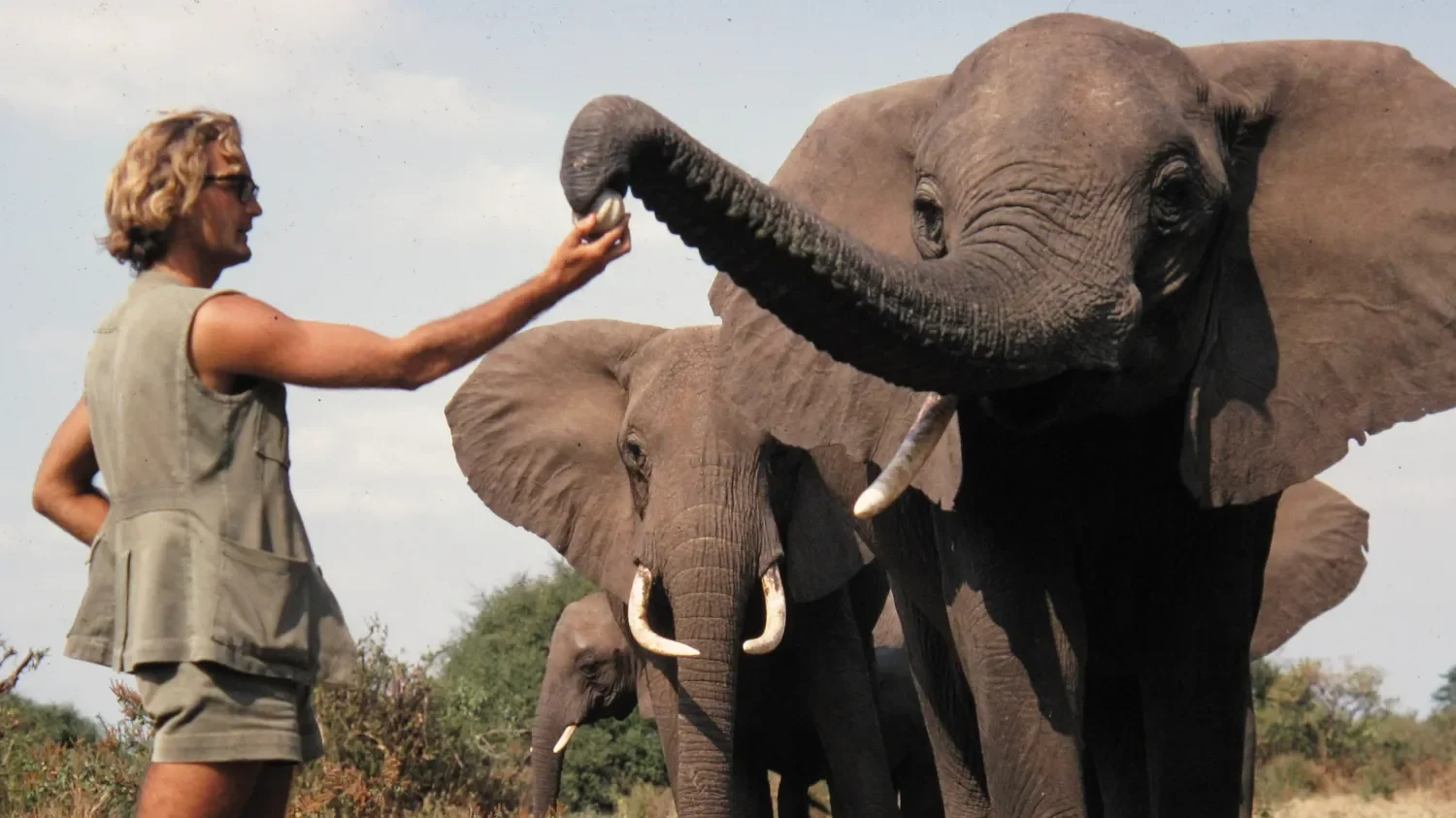
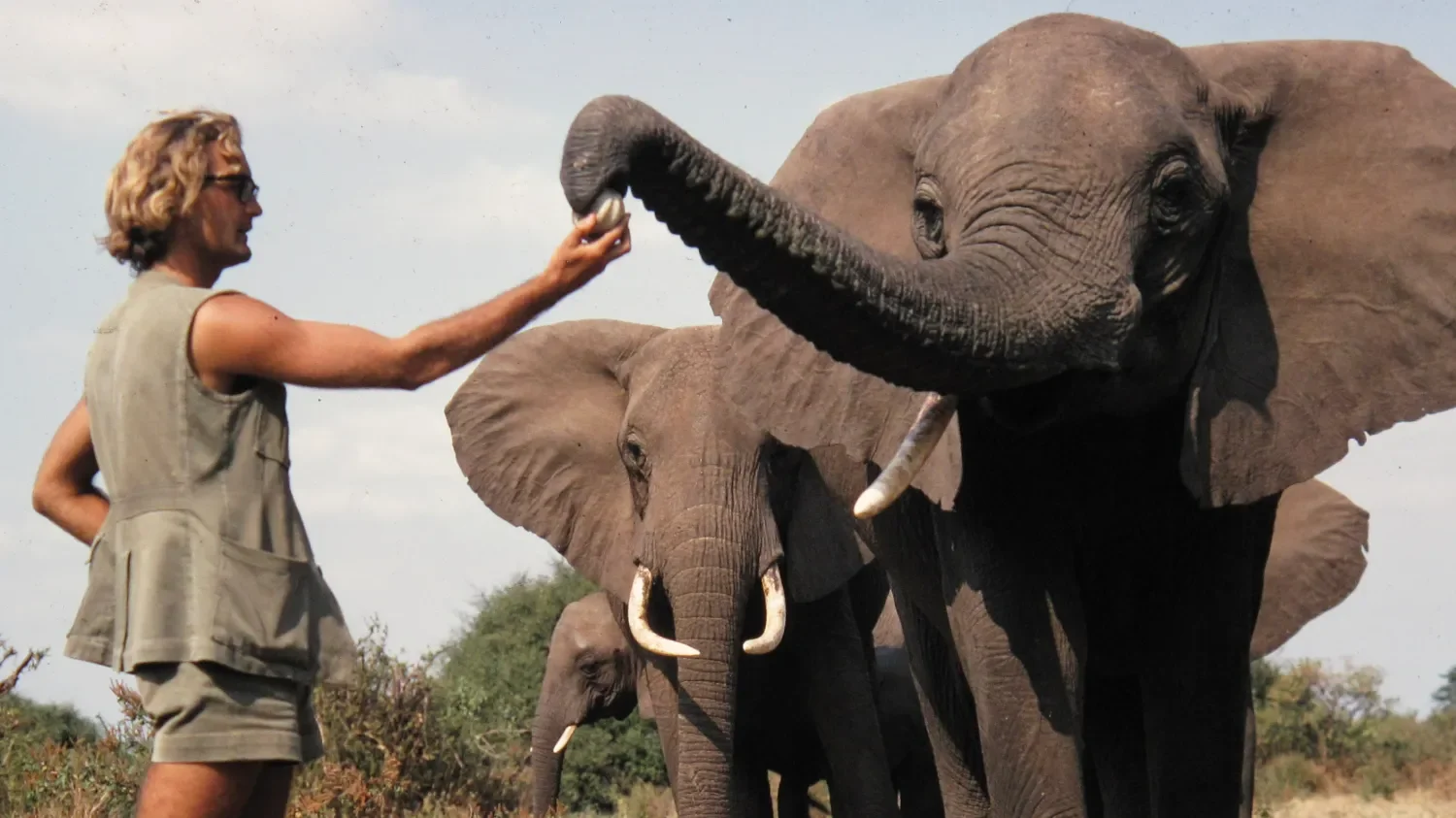
His four years in Manyara were “pure delight”. Long haired, bespectacled, often shirtless and barefoot, he lived in the bush, learned to recognise 500 elephants by their tusks and ears, and produced the first detailed scientific study of elephants’ social structures and behaviour.
He gave them names. Boadicea, a huge matriarch, regularly staged mock charges at his Land Rover. With Virgo he developed such a close relationship that she would let him tickle her trunk. He was struck by their intelligence, individuality and capacity for caring. “Elephants tend each other’s wounds, stand watch over the sick, and bury the dead,” he wrote. “I got completely hooked on them.”
He pioneered the art of collaring elephants with radio transmitters so he could track their movements. He learned to fly, and bought a plane so he could follow them more easily. He taught himself Swahili while recovering from being trampled by the rhino. He escorted Charles Lindbergh, the first man to fly non-stop across the Atlantic, into the bush where they came face to face with a lion.
He also met Oria Rocco, the daughter of Italian landholders in Kenya, at a party during one of his occasional returns to civilisation. He was instantly smitten though she was ten years his senior.
Shortly afterwards he landed unannounced at her family’s farm, and flew her back to the bush to photograph his elephants. Soon after that she moved in. Not long after that they had their first daughter, Saba, now a wildlife filmmaker and conservationist in Kenya. Douglas-Hamilton had to fly Oria to Nairobi when she went into labour unexpectedly early, narrowly beating the setting sun. The couple married in 1971, and had a second daughter, Dudu, now a conservationist who fights the illegal ivory trade in Africa and Asia.
The couple’s Manyara idyll ended when Douglas-Hamilton returned to Oxford to write his PhD thesis, but after two “miserable” years in England he took his wife and daughters back to Manyara to make a television documentary, The Family That Lives with Elephants, that was narrated by David Niven and made Douglas-Hamilton a household name.
He found a very different Africa. By the mid-1970s its elephants had become the target of industrial scale poaching caused by a sharply-rising demand – and prices - for ivory in an increasingly prosperous Japan and the West.
Douglas-Hamilton was one of the first to raise the alarm. “Never in our wildest dreams did we think men with automatic weapons would come one day and start shooting elephants,” he said. “I switched careers from somebody who was studying elephants’ lives to someone who was studying their deaths and getting that news out to the world.”
Between 1976 and 1979, alongside the International Union for Conservation of Nature (IUCN) and World Wide Fund for Nature (WWF), he instigated and helped conduct the first pan-African elephant census across 34 countries, and found that elephants were being killed at an unsustainable rate. He simultaneously conducted a parallel investigation into the size and nature of the illegal ivory trade.
Between 1980 and 1981 he battled with some success to restore three ravaged national parks in Uganda amid the lawlessness that followed the fall of President Idi Amin. Sudanese poachers shot at him as he flew overhead, puncturing his plane with bullet holes. He lived with his family in a looted cottage in Uganda’s Murchison Falls National Park that had been built for a visit by Queen Elizabeth, the Queen Mother, in the 1950s.
In the decade from 1979 Africa’s elephant population plummeted from an estimated 1.3 million to scarcely 600,000, and Douglas-Hamilton waged his battle to save them using data collected from exhaustive field research. “It was a dreadful time. I really spent a terrible twenty years doing that,” he said.
But he finally got his reward in 1989 when all international trade in ivory was banned under the Convention on International Trade in Endangered Species (CITES). That July in the Nairobi National Park he had the satisfaction of watching Daniel arap Moi, Kenya’s president, publicly burn 12 tons of poached elephant tusks to prevent them ever being sold.
The ban worked. The price of ivory collapsed. The poaching subsided, and elephant populations began to recover. He and Oria published a second book, Battle for the Elephants, and he helped the Discovery Channel make an IMAX film, Africa’s Elephant Kingdom. He advised the United Nations, the European Union, the US Fish and Wildlife Service, assorted African governments and various conservation NGOs.
Hoping to return to the field work that he loved, Douglas-Hamilton also set up Save the Elephants (STE) and a research station in northern Kenya’s Samburu National Reserve.
STE’s goal was to protect elephants not only from poaching, but from the relentless encroachment of humans on their natural habitats, by using science to deepen human understanding of those creatures. He helped develop GPS radio-tracking for elephants, the better to understand their movements so safe corridors could be created for them. The trackers showed, for example, how elephants crossing a danger zone will send a scout ahead to check it out then cross it rapidly at night.
Douglas-Hamilton also trained a new generation of researchers and conservationists, both African and western. One, Lucy King, discovered that elephants fear bees, and that a string of beehives can stop them entering and wrecking smallholdings.
But the relative lull in poaching did not last. In 2007 CITEs succumbed to pressure from Botswana, South Africa, Namibia and Zimbabwe to allow a one-off sale of stockpiled ivory to China. That stimulated the demand for ivory amongst China’s burgeoning middle-classes, triggering a fresh massacre of African elephants as the ivory price soared.
Douglas-Hamilton, by then a world-renowned authority on African elephants, returned to the fray. He lobbied the powerful, delivered lectures and gave interviews. In 2012 he appeared before the US Senate’s Foreign Relations Committee to warn about the “illegal killing of elephants on a massive scale” by organised criminal gangs. He worked closely with Hilary Clinton, then US Secretary of State, who regarded poaching as a threat to the security of African states, and hosted Bill and Chelsea Clinton in Samburu. He co-founded the Elephant Crisis Fund which raised more than $30 million to support anti-poaching initiatives.
He also sought to dissuade the Chinese from buying ivory by bringing Chinese celebrities and journalists to Kenya to see the problem for themselves, and helping WildAid run a public awareness campaign across China. Thousands of billboards featured Yao Ming, the basketball star, alongside an elephant and the words: ‘When the buying stops, the killing can too.’
International pressure on Beijing built until finally, in 2017, President Xi Jinping announced he was shutting down China’s domestic ivory market, and the poaching epidemic began to subside once more.
In the end it was not a wild elephant or rhinoceros that killed Douglas-Hamilton, not a poacher’s bullet or a crash in his beloved plane although he carried on flying until he was 80.
In February 2023 he and his wife were attacked by a swarm of African bees as they went for an evening walk on the family farm beside Lake Naivasha in Kenya’s Rift Valley. He was stung many times as he sought to protect Oria, who was then 90 years old, and went into anaphylactic shock. It took eight hours to get him to a hospital in Nairobi by road, and he remained in critical condition for five weeks. His heart never fully recovered, but he lived long enough to enjoy the release of an award-winning documentary about his life, A Life Among Elephants